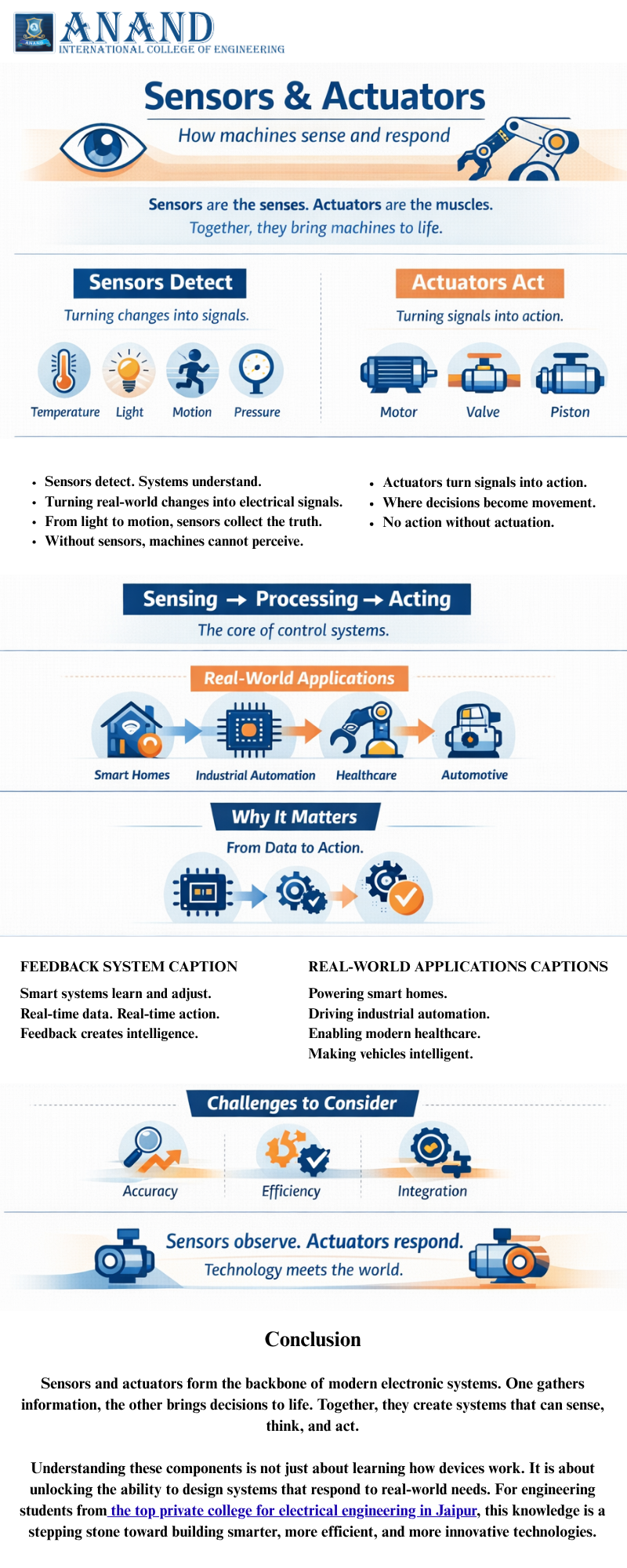
If electrical engineering were a living organism, sensors would be its senses and actuators would be its muscles. Together, they allow machines not just to exist, but to interact, respond, and adapt to the world around them. For engineering students from the best private college for electrical engineering in Jaipur, understanding these two components is like learning the language through which machines perceive and act.
Let’s explore how sensors and actuators quietly power everything from smartphones to industrial automation systems.
What Are Sensors?
At its core, a sensor is a device that detects changes in the environment and converts them into electrical signals. These changes could be physical, chemical, or even biological. Think of temperature shifts, light intensity, pressure, motion, or humidity. Sensors pick up these variations and translate them into data that electronic systems can understand.
For example, when your phone screen adjusts brightness automatically, a light sensor is at work. Similarly, a temperature sensor in an air conditioning system constantly monitors room conditions to maintain comfort.
What makes sensors fascinating is their ability to bridge the gap between the physical and digital worlds. They take real-world inputs and transform them into signals that microcontrollers and processors can interpret. Without sensors, electronic systems would be blind, deaf, and unresponsive.
Types of Sensors
Sensors come in many forms, each designed to detect a specific type of input. Temperature sensors measure heat levels and are widely used in HVAC systems and medical devices. Pressure sensors detect force per unit area and are common in automotive and industrial applications.
Motion sensors, often found in security systems and smartphones, detect movement using technologies like infrared or ultrasonic waves. Light sensors measure illumination and are used in devices ranging from cameras to streetlights.
Another important category is chemical sensors, which detect substances in the environment. These are used in applications like gas detection and environmental monitoring.
Each type of sensor operates on a different principle, but they all share a common purpose: converting physical phenomena into measurable electrical signals.
What Are Actuators?
While sensors gather information, actuators take action. An actuator is a device that converts electrical signals into physical movement or output. In simple terms, if sensors are the input system, actuators are the output system.
Imagine a smart irrigation system. A soil moisture sensor detects dryness in the soil. Based on this input, an actuator, such as a motor or valve, opens to release water. This seamless interaction between sensing and action is what makes modern systems intelligent.
Actuators can produce different types of motion, including linear, rotary, or oscillatory. They are essential in systems where physical movement or control is required.
Types of Actuators
Actuators can be classified based on the type of energy they use. Electrical actuators are among the most common and include motors and solenoids. These are widely used in robotics, home appliances, and industrial machines.
Hydraulic actuators use fluid pressure to generate motion. They are powerful and often found in heavy machinery like excavators. Pneumatic actuators, on the other hand, use compressed air and are commonly used in automation systems.
There are also thermal actuators, which rely on temperature changes to create movement, and piezoelectric actuators, which generate motion when subjected to an electric field. Each type has its own advantages depending on the application.
How Sensors and Actuators Work Together
The real magic happens when sensors and actuators work in coordination. This interaction forms the foundation of control systems, which are central to electronics engineering.
A simple example is an automatic fan. A temperature sensor detects the room temperature. If it rises above a certain threshold, the system sends a signal to an actuator, which turns on the fan. Once the temperature drops, the actuator turns the fan off.
This loop of sensing, processing, and acting is known as a feedback system. It allows systems to adjust their behavior dynamically based on real-time data.
In more advanced applications, such as robotics or autonomous vehicles, multiple sensors and actuators work together in complex networks. Sensors provide continuous input about the environment, while actuators execute precise movements based on that input
Applications in Real Life
Sensors and actuators are everywhere, often working behind the scenes. In healthcare, sensors monitor vital signs like heart rate and oxygen levels, while actuators control devices such as infusion pumps.
In the automotive industry, sensors detect speed, proximity, and engine conditions. Actuators then adjust braking systems, fuel injection, and steering mechanisms. This is especially evident in modern vehicles with advanced driver assistance systems.
In industrial automation, sensors monitor parameters like temperature, pressure, and flow. Actuators respond by controlling valves, motors, and machinery. This ensures efficiency, safety, and precision in manufacturing processes.
Even in smart homes, sensors detect motion, light, and temperature, while actuators control lighting, heating, and security systems. The result is a living space that adapts to the user’s needs.
Importance for Engineering Students
For students of electronics engineering, sensors and actuators are not just theoretical concepts. They are foundational elements that appear in almost every practical application. Whether you are working on embedded systems, robotics, IoT, or automation, a solid understanding of these components is essential.
Learning about sensors helps you understand how to collect accurate data from the environment. On the other hand, studying actuators teaches you how to translate that data into meaningful actions.
This knowledge also plays a crucial role in system design. Choosing the right sensor or actuator can significantly impact the performance, efficiency, and reliability of a system.
Challenges and Considerations
Working with sensors and actuators is not always straightforward. Sensors can be affected by noise, environmental conditions, and calibration issues. Ensuring accuracy and reliability requires careful design and testing.
Actuators, meanwhile, must be selected based on factors like power requirements, response time, and load capacity. An inefficient actuator can lead to energy loss or system failure.
Another challenge is integration. Combining multiple sensors and actuators into a single system requires effective communication and control strategies. This is where microcontrollers and programming skills come into play.
Conclusion
Sensors and actuators form the backbone of modern electronic systems. One gathers information, the other brings decisions to life. Together, they create systems that can sense, think, and act.
Understanding these components is not just about learning how devices work. It is about unlocking the ability to design systems that respond to real-world needs. For engineering students from the top private college for electrical engineering in Jaipur, this knowledge is a stepping stone toward building smarter, more efficient, and more innovative technologies.
Once you start noticing them, you will realize that sensors and actuators are everywhere, quietly orchestrating the rhythm of the modern world.