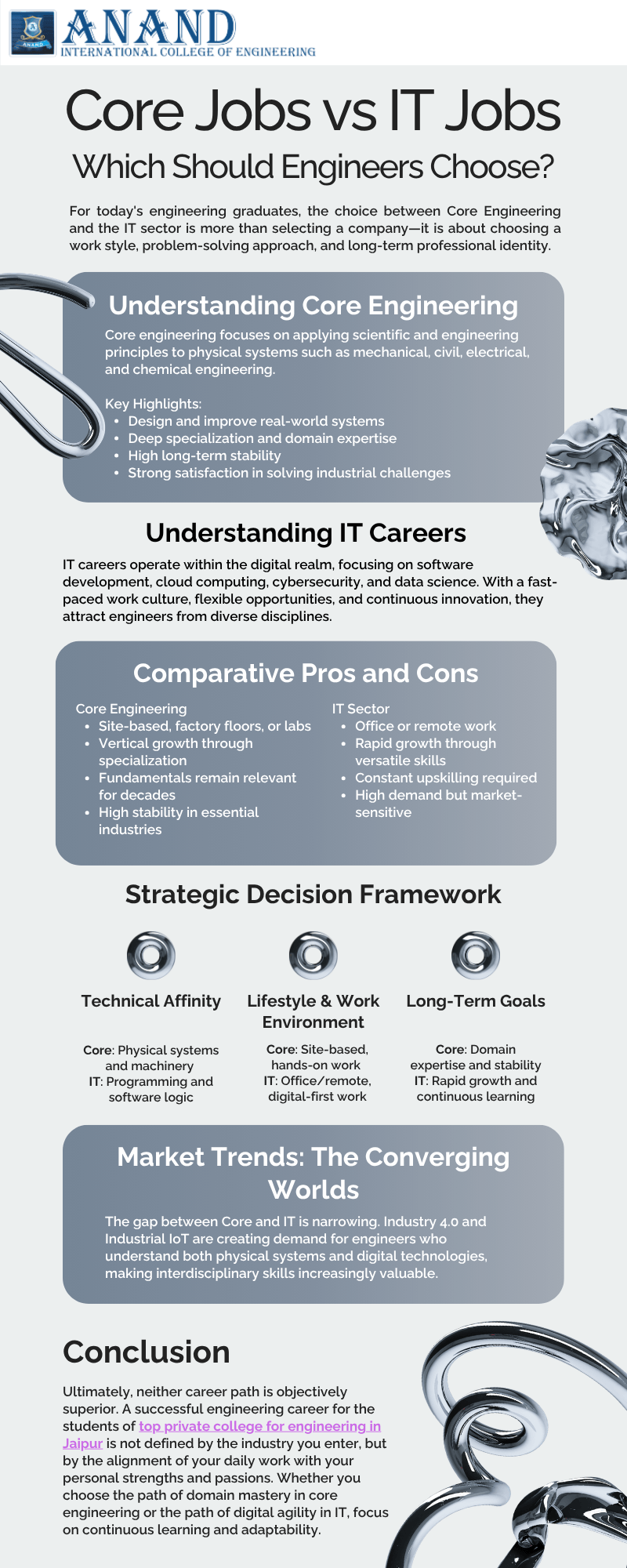
For today’s engineering graduates from the best private college for engineering in Jaipur, the career landscape is more complex and diverse than ever before. The traditional path of pursuing a role directly related to one’s academic major commonly referred to as a “core” job, now competes with the immense pull of the Information Technology (IT) sector. This modern dilemma is not merely about choosing a company; it is about choosing a lifestyle, a methodology of problem-solving, and a long-term professional identity. Both paths offer significant rewards, yet they demand different temperaments and offer vastly different daily experiences.
Understanding Core Engineering
Core engineering roles represent the practical application of fundamental scientific and mathematical principles within a specific branch of study, such as mechanical, civil, electrical, or chemical engineering. These positions are defined by their connection to physical systems. A core engineer might design more efficient internal combustion engines, manage the structural integrity of a skyscraper, or optimize the output of a power grid. The work is tangible; you can often see, touch, or stand inside the results of your labor.
The career trajectory in core engineering is predominantly “vertical.” Success is built upon the accumulation of deep, specialized knowledge over many years. As an engineer progresses, they become subject matter experts whose value is rooted in their nuanced understanding of complex physical constraints and industry standards. While the initial learning curve can be steep and entry-level salaries may sometimes lag behind those in tech, the long-term stability is often higher. There is a profound sense of satisfaction found in solving real-world industrial problems that have a direct impact on infrastructure and physical innovation.
Understanding IT Careers
In contrast, IT careers operate within the digital realm, focusing on software development, cloud computing, cybersecurity, and data science. The IT sector is famously inclusive, welcoming engineers from all disciplines who possess strong logical reasoning and programming skills. The work revolves around abstract logic and digital tools to create scalable solutions, from mobile applications to complex enterprise software. This sector moves at a relentless pace, driven by the constant cycle of digital transformation.
IT professionals often enjoy a modern work culture characterized by remote work options, agile methodologies, and high initial compensation packages. The thrill here lies in the speed of iteration and the ability to reach millions of users with a single code deployment.
Comparative Pros and Cons
| Feature | Core Engineering | IT Sector |
|---|---|---|
| Work Environment | Site-based, factory floors, or labs. Hands-on and physical. | Office or remote. Digital-first and screen-heavy. |
| Growth Pattern | Vertical: Stability through specialization and domain mastery. | Horizontal: Rapid growth through versatile and transferable skills. |
| Skill Longevity | Fundamentals remain relevant for decades; slower evolution. | Fast-paced; requires constant upskilling as tech stacks change. |
| Stability | High job security in essential industries and infrastructure. | Market-sensitive; high demand but subject to tech cycles. |
Strategic Decision Framework
Choosing between these paths requires honest self-reflection. Students should evaluate themselves based on three primary pillars:
- Technical Affinity: Do you find more joy in understanding how a physical mechanism works, or in the logic of an algorithm? If you prefer working with hardware and physical constraints, core is likely your home. If you enjoy the abstraction of logic and software, IT may be a better fit.
- Lifestyle and Work Environment: Consider your daily surroundings. Core jobs often involve travel to sites or manufacturing plants, requiring physical presence and potentially more rigid schedules. IT jobs frequently offer more flexibility, though they can also lead to longer hours spent in front of a computer screen.
- Long-Term Goals: Are you looking for a “sprint” in your early career with high financial rewards and frequent changes? Or are you looking for a “marathon” where you build a legacy of expertise in a specific industrial field?
Market Trends: The Converging Worlds
It is important to note that the line between core and IT is increasingly blurring. We are entering an era of “Industrial IoT” and Industry 4.0, where traditional factories are being digitized. Core industries now desperately need engineers who understand both physical machinery and data analytics. Conversely, the IT sector is increasingly seeking domain-specific engineers to build specialized software for aerospace, automotive, and biotech industries. This convergence means that even if you start in one, your skills in the other will remain highly valuable.
Conclusion
Ultimately, neither career path is objectively superior. A successful engineering career for the students of top private college for engineering in Jaipur is not defined by the industry you enter, but by the alignment of your daily work with your personal strengths and passions. Whether you choose the path of domain mastery in core engineering or the path of digital agility in IT, focus on continuous learning and adaptability. By choosing the environment where you feel most engaged, you ensure a professional journey that is both sustainable and deeply meaningful.