
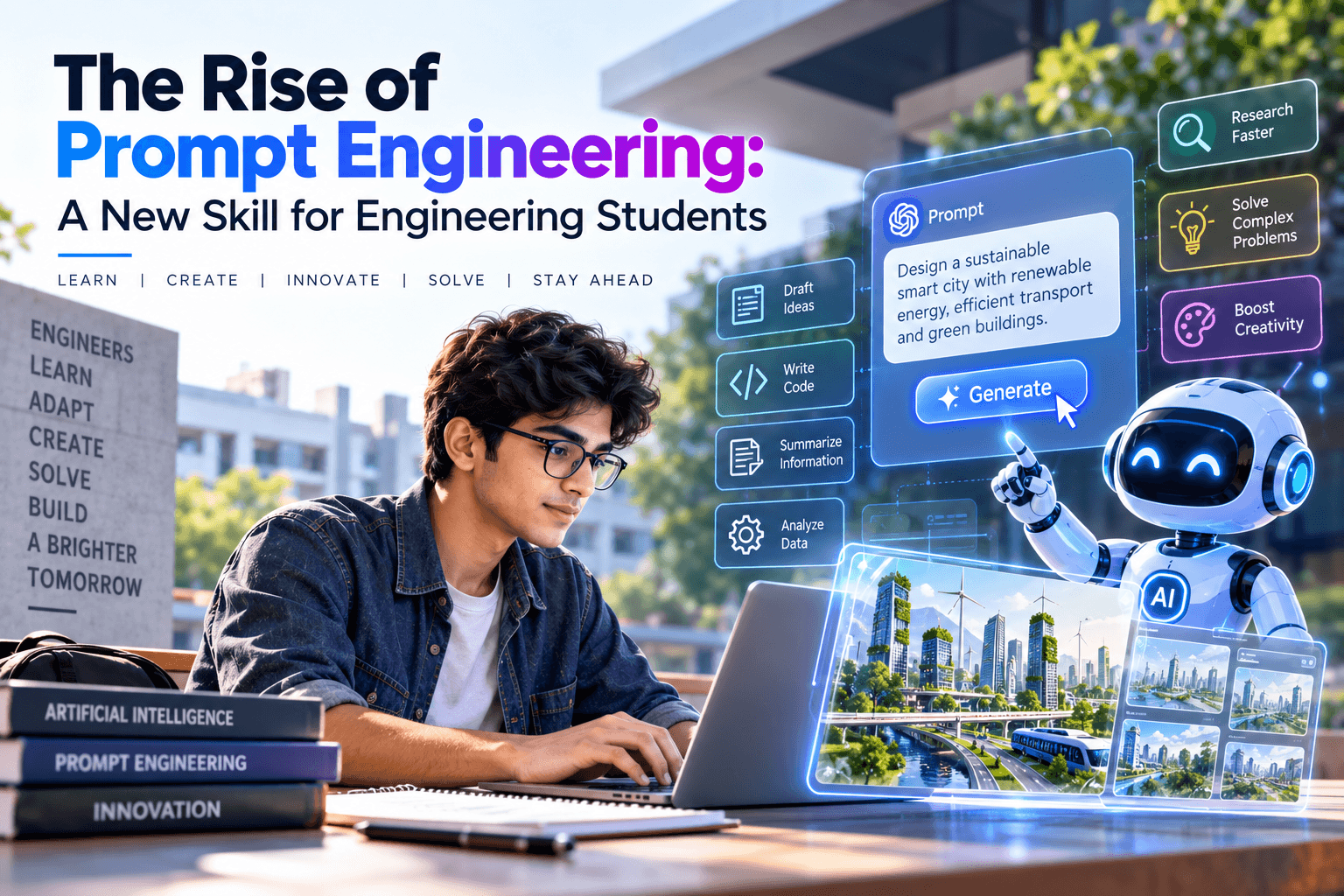
Artificial intelligence is changing the way engineers learn, work and solve problems. From writing code and analysing data to designing products and automating repetitive tasks, AI tools are becoming part of everyday engineering workflows. But there is an interesting shift happening alongside the rise of AI. Knowing how to use an AI tool is no longer enough. Knowing how to communicate with it effectively is becoming a skill in itself.
This is where prompt engineering comes into the picture.
Prompt engineering is the practice of creating clear and effective instructions, or prompts, that help AI systems produce useful and relevant results. For engineering students from the top AI engineering college in Jaipur, it is not about learning a complicated programming language but about learning how to think clearly, ask better questions and guide AI towards the desired outcome.
What Exactly Is Prompt Engineering?
Think about asking a classmate to help you solve a difficult engineering problem. If you simply say, “Solve this,” they may not know what approach you want, what level of explanation you need or which information is important.
But if you explain the problem, provide the relevant data, mention the method you have been studying and ask for the solution step by step, the response is likely to be much more useful.
AI works in a similar way.
A prompt provides the context and instructions an AI system needs to understand what you want. A vague prompt may produce a generic answer, while a well-structured prompt can result in a much more focused response.
For example, instead of asking an AI tool, “Explain machine learning,” an engineering student could ask:
“Explain machine learning to a second-year engineering student using a real-world example from manufacturing. Keep the explanation simple and include three applications.”
The second prompt gives the AI much more direction.
Why Is Prompt Engineering Becoming Important?
AI is moving beyond being a separate technology that only specialists use. It is increasingly becoming a tool used across different engineering disciplines.
A civil engineering student might use AI to brainstorm sustainable construction approaches. A mechanical engineering student could explore design alternatives or analyse technical concepts. An electrical engineering student could use AI while learning about circuits or embedded systems. A computer science student might use it for debugging, documentation or understanding unfamiliar code.
The technology may be the same, but the way it is used depends heavily on the instructions given to it.
This makes prompt engineering valuable because it combines technical understanding with communication and problem-solving skills.
Prompt Engineering Is More Than “Talking to AI”
There is a common misconception that prompt engineering simply means knowing clever phrases to type into an AI chatbot.
In reality, effective prompting involves several useful habits.
First, students need to understand the problem they are trying to solve. Second, they need to provide relevant context. Third, they need to clearly define the expected output. Finally, they need to evaluate the response instead of accepting it blindly.
This last part is particularly important.
AI can produce information that sounds convincing but may be incomplete or incorrect. An engineering student still needs subject knowledge and critical thinking to verify the result.
In other words, AI can help you think, but it should not replace your thinking.
How Engineering Students Can Build This Skill
The good news is that students do not need to wait until they graduate to start learning prompt engineering. They can practise it alongside their regular studies.
Start with everyday academic tasks.
Ask an AI tool to explain a difficult concept at three different levels. Ask it to identify mistakes in a piece of code. Give it a problem and ask for multiple possible approaches. Provide a technical paragraph and ask for a simpler explanation. Then compare the responses.
Students can also experiment with giving AI a specific role, context, constraints and output format.
For example, instead of asking for ideas on a college project, try:
“You are helping a team of engineering students develop a low-cost solution for reducing water wastage on campus. Suggest five practical ideas that can be prototyped within a limited student budget. For each idea, mention the materials required, working principle and possible challenges.”
The prompt itself becomes a way of structuring the problem.
Prompt Engineering Across Engineering Branches
One of the most interesting aspects of prompt engineering is that it is not limited to computer science.
Computer Science Engineering: Students can use prompts for code generation, debugging, testing, documentation and learning new programming concepts.
Mechanical Engineering: AI can help students explore design concepts, understand manufacturing processes and generate ideas for engineering projects.
Civil Engineering: Students can use AI to brainstorm sustainable construction methods, understand structural concepts and organise research.
Electrical Engineering: Prompting can support learning in areas such as electronics, circuits, control systems and embedded technologies.
Artificial Intelligence and Data Science Engineering: Students can go further by exploring AI models, datasets, evaluation techniques and automated workflows.
The ability to work effectively with AI can therefore become a useful layer on top of a student’s core engineering knowledge.
The Human Skill Behind the AI Skill
Interestingly, the rise of prompt engineering highlights something very human: the ability to communicate clearly.
A good engineer has always needed more than technical knowledge. Engineers communicate with teams, clients, researchers and people from different backgrounds. They need to define problems, ask meaningful questions and explain complex ideas.
Prompt engineering strengthens many of these same abilities.
It encourages students to be precise about what they want, recognise missing information, break large problems into smaller parts and assess whether an answer actually solves the original problem.
These are valuable engineering habits even when there is no AI involved.
The Future of Prompt Engineering
As AI systems become more capable, the way people interact with them will continue to evolve. Some of today’s prompting techniques may eventually become less important as AI becomes better at understanding natural language and context.
However, the underlying skill is likely to remain relevant: knowing how to define a problem and communicate the desired outcome clearly.
For engineering students from the top engineering college in Jaipur, this means prompt engineering should not be viewed as a shortcut to avoid learning technical subjects. Instead, it can be treated as a new tool in the engineering toolbox.
The engineers of the future may not simply ask, “What can AI do?” They may ask a more useful question: “How can I use AI to solve this problem better, while still applying my own knowledge and judgement?” That shift in thinking is where the real value of prompt engineering begins.