Every app click, online payment, search, purchase and digital interaction creates data. But collecting data is only the beginning. Before businesses can use it for analytics, artificial intelligence or decision-making, someone has to organize it, move it, clean it and make it reliable. That is where data engineering enters the picture.
As we move into 2027, data engineering is becoming an increasingly relevant career option for engineering students. The rapid adoption of cloud computing, AI and data-driven technologies means companies need professionals who can build the infrastructure behind these systems. For students from the top private college for engineering in Jaipur interested in programming, databases and problem-solving, data engineering offers an exciting path worth exploring.
What Does a Data Engineer Actually Do?
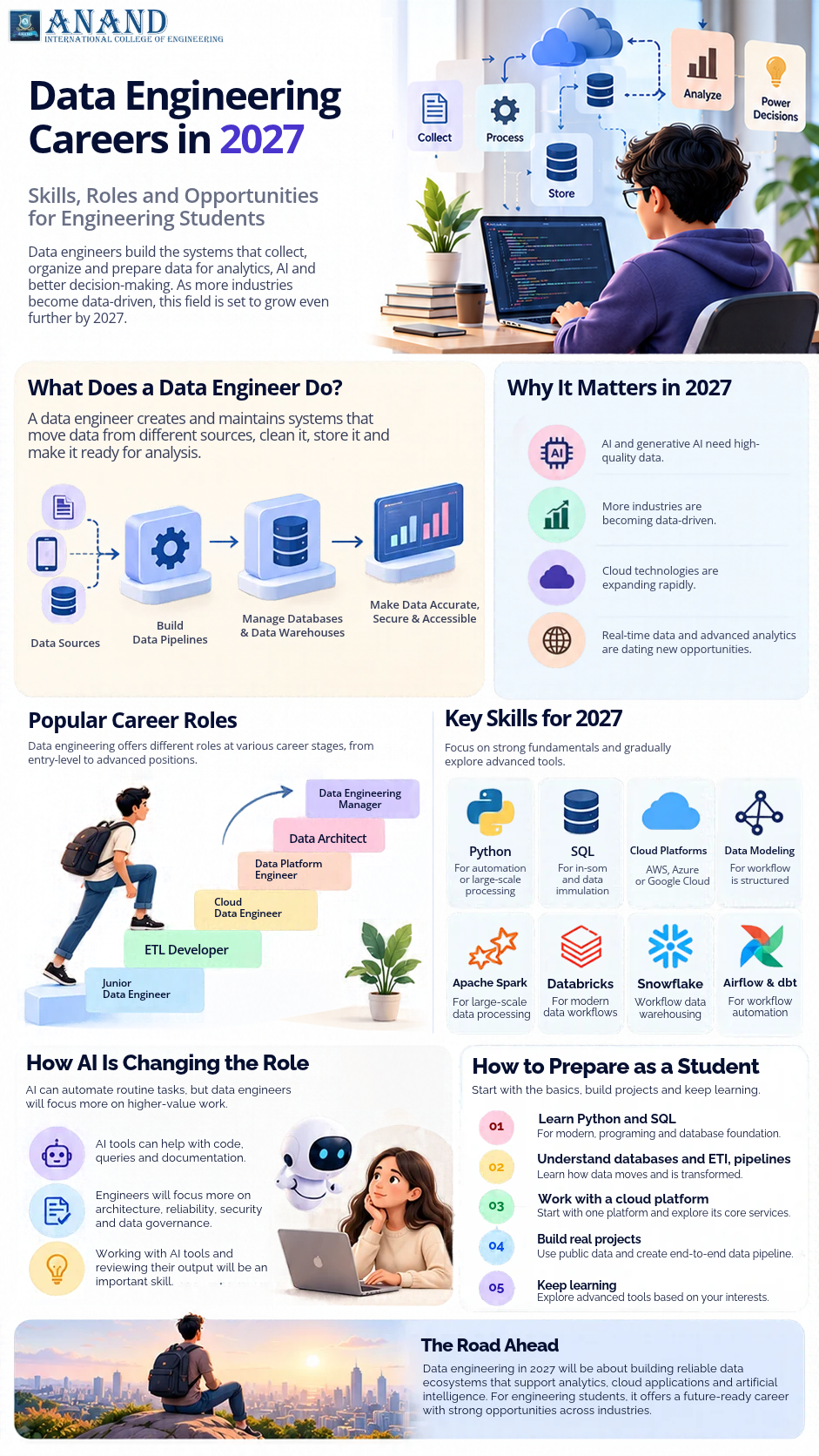
A data engineer builds and maintains systems that allow data to travel from different sources to places where it can be stored, processed and analyzed.
Imagine an e-commerce company receiving information from its website, mobile application, payment system, inventory software and customer support platform. All this information exists in different formats and locations. A data engineer creates pipelines that bring this information together and prepare it for analysts, data scientists and AI systems.
Their responsibilities may include developing data pipelines, managing databases, designing data warehouses, integrating multiple data sources and ensuring that information remains accurate, secure and accessible.
In simple terms, if data is the fuel of a digital organization, data engineers build the pipelines and storage systems that keep that fuel flowing.
Why Data Engineering Will Matter in 2027
The rise of artificial intelligence has made data engineering even more important. AI models are only as useful as the information available to them. Businesses experimenting with generative AI, machine learning and intelligent automation need clean, well-organized and continuously updated data.
Current hiring patterns already show that traditional foundations such as SQL, Python, cloud platforms, data warehousing and ETL remain important for data engineering roles. At the same time, newer areas such as AI data pipelines, vector databases, data governance and MLOps are becoming increasingly relevant.
This means the data engineer of 2027 may work on much more than conventional databases. Engineers could help prepare information for recommendation systems, real-time applications, predictive models and enterprise AI assistants.
Career Opportunities in Data Engineering
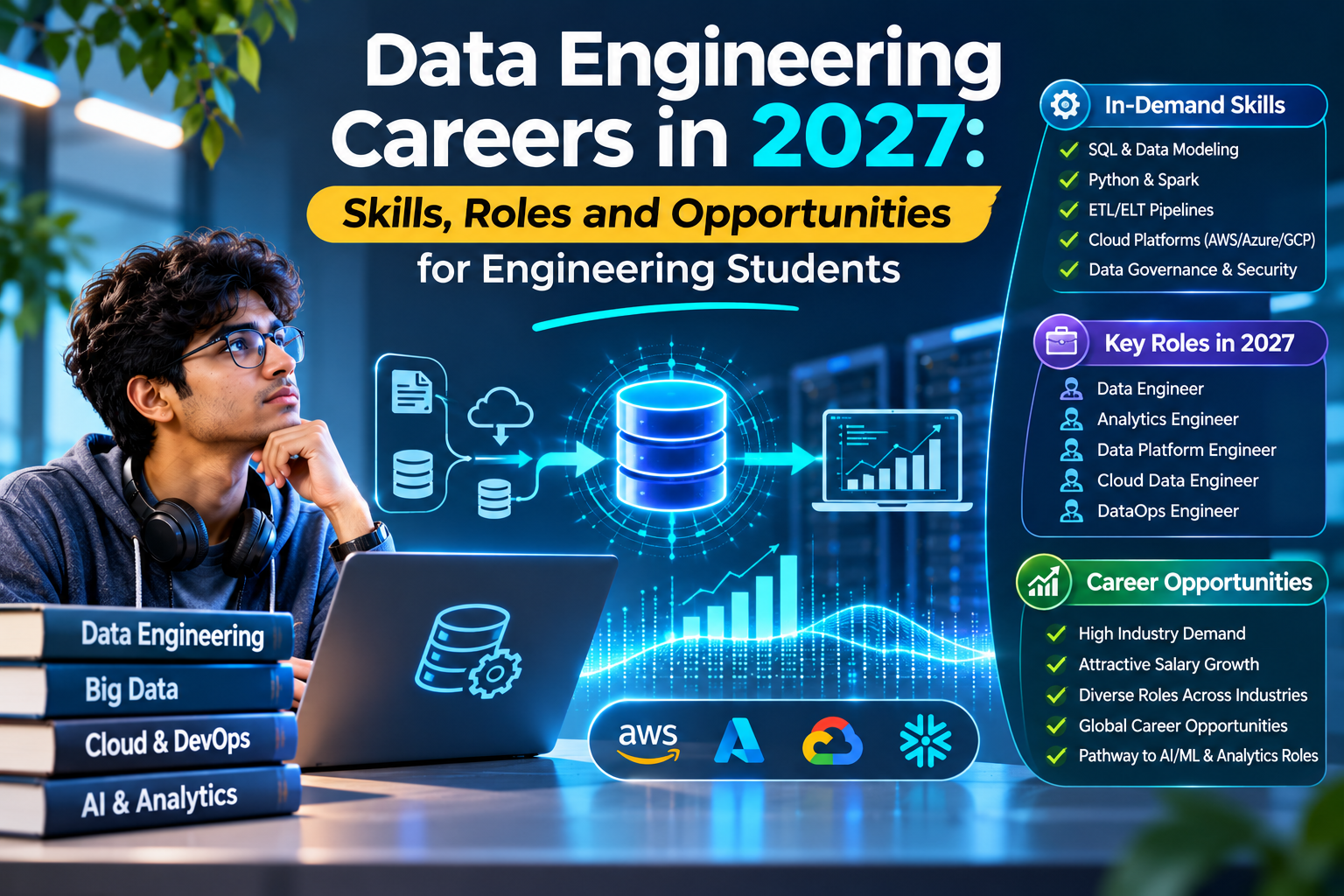
Data engineering is not limited to one job title. Students entering the field can gradually explore roles such as Junior Data Engineer, ETL Developer, Cloud Data Engineer, Big Data Engineer, Data Platform Engineer and Analytics Engineer.
With experience, professionals can progress towards senior positions such as Data Architect, Lead Data Engineer or Data Engineering Manager. Another interesting direction is emerging around AI Data Engineering, where professionals build and manage the data infrastructure required by machine learning and generative AI applications.
The career also provides flexibility because data engineering skills are required across industries. Banking, healthcare, manufacturing, retail, e-commerce, telecommunications, education and technology companies all generate large quantities of information that need to be managed effectively.
Skills Students Should Develop for 2027
Students do not need to learn every data technology available. A stronger approach is to develop solid fundamentals first.
SQL is one of the most important skills because data engineers constantly work with databases. Students should become comfortable with querying, filtering, joining and transforming data.
Python is another valuable skill. It is widely used for automation, data processing and building pipelines. Recent analyses of data-engineering job postings continue to place SQL and Python among the most frequently requested skills.
Students should also understand database concepts and data modelling. Knowing how information should be structured can be more valuable than simply knowing how to use a particular software tool.
Cloud computing is another important area. Platforms such as AWS, Microsoft Azure and Google Cloud have become central to modern data infrastructure. Students do not necessarily need to master all three. Learning one cloud ecosystem properly and understanding the basic concepts behind cloud storage, databases and processing can provide a strong starting point.
As students advance, they can explore technologies such as Apache Spark, Databricks, Snowflake, Airflow and dbt depending on the type of roles they want to pursue.
How AI Is Changing the Data Engineer’s Role
One common question students may have is whether AI will eventually automate data engineering.
AI tools can certainly automate parts of the work. They can help generate SQL queries, suggest pipeline logic, identify errors and assist with documentation. However, automation also changes what employers expect from engineers.
Instead of spending all their time writing repetitive pipeline code, future data engineers may focus more on architecture, reliability, security, governance and solving business problems. Emerging AI-assisted data platforms are already moving in this direction.
Students should therefore learn how to work with AI tools rather than compete against them. The ability to review AI-generated solutions, identify mistakes and make sound engineering decisions will become increasingly useful.
How Can Engineering Students Prepare?
A student interested in data engineering should begin with programming and databases rather than jumping directly into dozens of advanced tools. Start with Python and SQL, learn database fundamentals and then understand how ETL and ELT pipelines work.
After that, build practical projects.
For example, you could collect information from a public dataset, clean it using Python, store it in a database and create an automated pipeline to update it. Later, the same project could be moved to a cloud platform.
Such projects help students understand how different concepts connect. They also provide something meaningful to discuss during internships, placements and technical interviews.
Students from Computer Science, Information Technology, Artificial Intelligence and Data Science branches may find the transition particularly natural, but the field is not restricted to these disciplines. Any engineering student willing to develop programming, database and analytical skills can explore the career.
Concluding Thoughts
Data engineering in 2027 will not simply be about moving information from one database to another. It will increasingly involve building reliable data ecosystems that support analytics, cloud applications and artificial intelligence.
For engineering students from the top private college for engineering in Jaipur, this creates an interesting opportunity. Instead of trying to learn every new technology appearing in the market, students should focus on strong fundamentals, practical projects and continuous learning.
AI may change the tools used by data engineers, but organizations will still need people who understand where data comes from, how it should be structured and whether it can be trusted. That makes data engineering a career where technical knowledge, logical thinking and real-world problem-solving can come together to build the invisible infrastructure powering the digital world.