Artificial Intelligence is no longer a futuristic idea that exists only in sci-fi movies or research labs. In 2026, AI is becoming a part of everyday life. From virtual assistants and recommendation systems to self-driving technology and smart healthcare solutions, AI is shaping industries at an incredible pace. For engineering students from the top private engineering college in Jaipur, this opens the door to one of the most exciting and fast-growing career paths in the world.
But many students still ask the same question: How do I actually build a career in AI? The field may seem vast and technical at first, but with the right direction and consistent effort, it becomes far more approachable than it appears.
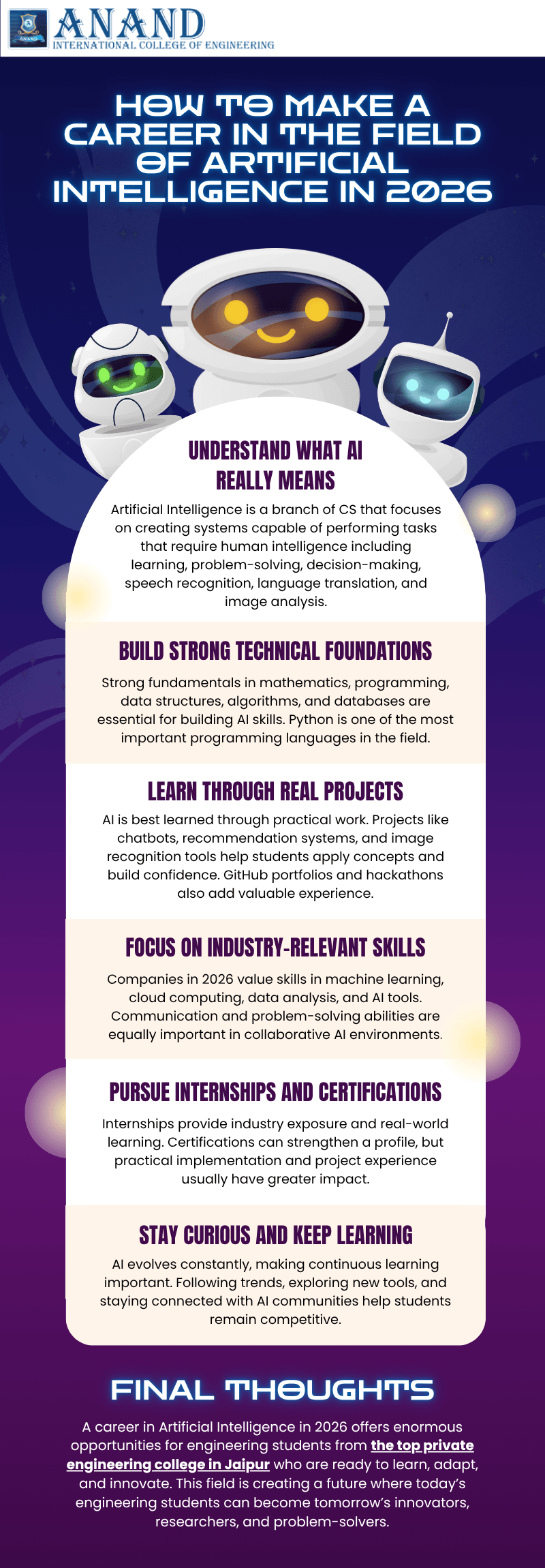
Understand What Artificial Intelligence Really Means
Before choosing AI as a career, it is important to understand what the field includes. Artificial Intelligence is a branch of computer science that focuses on creating systems capable of performing tasks that usually require human intelligence. These tasks include learning, problem-solving, decision-making, speech recognition, language translation, and image analysis.
AI itself is a broad umbrella. Under it, there are several important areas such as Machine Learning, Deep Learning, Natural Language Processing, Robotics, and Computer Vision. Some students become interested in building chatbots, while others enjoy working with data or developing smart automation systems. Exploring these areas early can help students discover where their interests truly lie.
Build Strong Technical Foundations
A successful career in AI starts with strong fundamentals. Students often rush toward advanced tools and trendy applications without understanding the basics. That approach usually creates confusion later.
Mathematics plays a major role in AI. Concepts like probability, statistics, linear algebra, and calculus are widely used in machine learning models. Programming skills are equally important. Languages such as Python are commonly used because of their simplicity and extensive AI libraries.
Apart from coding, students should also develop a solid understanding of data structures, algorithms, and database management. AI systems process enormous amounts of information, so knowing how data works behind the scenes becomes extremely valuable.
The learning process may feel challenging in the beginning, especially for students who are new to coding or mathematics. However, consistency matters more than perfection. Even spending one focused hour daily can lead to major improvement over time.
Also Read: 8 Most Demanding Engineering Courses in 2026
Learn Through Real Projects
One of the biggest mistakes students make is learning only through theory. AI is a practical field. Employers and recruiters want to see what candidates can actually build.
Working on projects helps students apply concepts in real-world situations. A simple chatbot, a movie recommendation system, a handwritten digit recognizer, or a face detection application can become excellent starting points. These projects not only improve technical skills but also build confidence.
Students should gradually move toward more advanced projects as they gain experience. Participating in hackathons, coding competitions, and AI challenges can also provide valuable exposure. These events often feel like innovation festivals where ideas, pressure, teamwork, and creativity collide in the best possible way.
Creating a portfolio on platforms like GitHub is another smart step. It allows students to showcase their work publicly and demonstrate their growth journey to recruiters.
Focus on Industry-Relevant Skills
The AI industry evolves rapidly. Technologies that are popular today may change within a few years. Because of this, students should focus on adaptable skills rather than chasing every new trend.
In 2026, companies are actively looking for candidates who understand machine learning frameworks, cloud computing, data analysis, and AI ethics. Familiarity with tools like TensorFlow, PyTorch, and cloud platforms can provide a competitive advantage.
Communication skills also matter more than many students realize. AI professionals often work in teams and need to explain technical concepts to non-technical people. The ability to present ideas clearly can make a huge difference during internships, interviews, and collaborative projects.
Problem-solving is another essential skill. AI is not just about writing code. It is about identifying challenges and building intelligent solutions that create real value.
Also Read: The Rise of Edge AI: A New Frontier for Computer and Electronics Engineers
Pursue Internships and Certifications
Internships can significantly accelerate a student’s AI career. They provide practical exposure, industry understanding, and networking opportunities. Even a short internship can teach lessons that textbooks never cover.
Students should start applying for internships early instead of waiting until graduation. Startups, research labs, and tech companies often welcome enthusiastic learners who are willing to experiment and contribute.
Certifications can also strengthen a student’s profile. Online learning platforms now offer high-quality AI and machine learning courses from leading universities and technology companies. While certificates alone do not guarantee a job, they show initiative and commitment toward learning.
At the same time, students should avoid collecting certifications endlessly without applying the knowledge. In AI, practical implementation always carries greater weight than a long list of completed courses.
Stay Curious and Keep Learning
Artificial Intelligence is one of those fields where learning never truly stops. New research papers, tools, and innovations appear constantly. Students who remain curious and adaptable often grow faster than those who rely only on classroom learning.
Reading technology blogs, following AI communities, watching expert discussions, and exploring research trends can help students stay updated. Even small habits like experimenting with new tools or reading about emerging AI applications can gradually expand knowledge.
The journey into AI may sometimes feel overwhelming because of the amount of information available. That is completely normal. Every expert in the field once started with confusion, mistakes, and small experiments.
Final Thoughts on How to Build Career in Artificial Intelligence 2026
A career in Artificial Intelligence in 2026 offers enormous opportunities for engineering students who are ready to learn, adapt, and innovate. The field combines creativity with technology in a way few other careers can. One day, students from the best private college for Artificial Intelligence Engineering in Jaipur may be building intelligent healthcare systems. Another day, they could be designing smarter transportation networks or developing AI tools that improve education itself.
The path does not require students to know everything from the beginning. What matters most is curiosity, persistence, and the willingness to keep building skills step by step. AI is not just transforming industries. It is creating a future where today’s engineering students can become tomorrow’s innovators, researchers, and problem-solvers.