
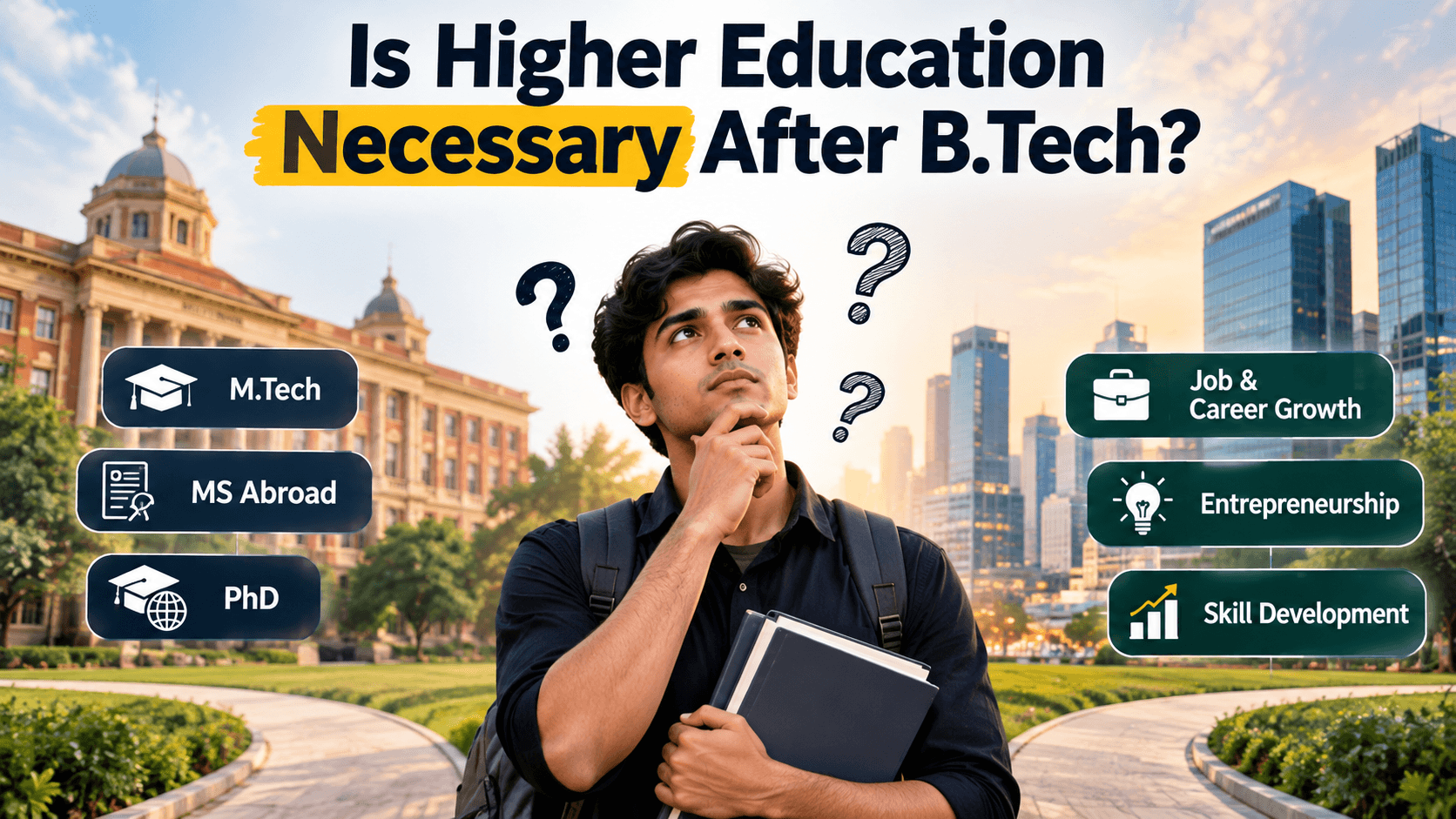
Completing a B.Tech degree from the best private college for B.Tech in Jaipur is a significant milestone for an engineering student. After four years of lectures, practicals, projects, examinations, internships and perhaps a few too many late-night submissions, graduation can feel like the finish line. But for many students, another question quickly appears: What next?
Should you start working, pursuing an M.Tech, go for an MBA, prepare for government examinations, study abroad, or focus on developing your skills independently?
The truth is that there is no single right answer. Higher education after B.Tech is not necessary for every engineering student, but for some career paths, it can make a meaningful difference. The right choice depends on your career goals, interests, financial situation and the kind of professional you want to become.
What Does Higher Education After B.Tech Mean?
Higher education after B.Tech can take several forms. Some students choose an M.Tech or another specialized postgraduate engineering programme. Others pursue an MBA to move towards management and business roles. Some opt for an MS abroad, while others choose certifications, professional courses or specialized programmes in areas such as artificial intelligence, data science, cybersecurity or renewable energy.
This means higher education does not necessarily have to mean spending another two or three years in a traditional classroom.
When Higher Education Can Be Useful
For students who want to specialize deeply in a particular field, postgraduate education can provide valuable opportunities.
Imagine a computer science student who becomes fascinated by artificial intelligence during their B.Tech. A postgraduate programme can provide a structured environment to explore machine learning, advanced algorithms, research and emerging applications in greater depth.
Similarly, an engineering graduate interested in research, teaching or specialized technical roles may benefit from pursuing an M.Tech or MS.
Higher education can also be useful when a particular career requires or strongly values advanced qualifications. Research-oriented careers and some specialized technical positions may involve postgraduate or doctoral-level study.
For students planning to work internationally, an MS can also provide exposure to different academic systems, research environments, industries and professional networks.
When Working After B.Tech May Make More Sense
Higher education is not automatically better simply because it means another degree.
For some students, entering the workforce immediately can be the better learning experience. Engineering is a practical discipline, and real projects can teach lessons that textbooks cannot always provide.
Working after B.Tech can help you understand what you actually enjoy.
You might discover that the coding you loved during college is not the part of technology you want to pursue professionally. Or perhaps you realize that you enjoy managing projects and working with clients more than solving technical problems.
Your first job can become a kind of career laboratory. You gain practical experience, understand workplace expectations and learn where your strengths lie and after gaining experience, you can also return to higher education with a clearer purpose.
Skills Can Matter as Much as Degrees
The modern engineering workplace increasingly values what you can do, not only what is written on your certificate.
A B.Tech graduate entering the technology sector may need skills in programming, data analysis, cloud computing, cybersecurity, AI tools or software development. A mechanical engineer may benefit from knowledge of automation, CAD, robotics or advanced manufacturing. Civil engineers may need familiarity with BIM, sustainable construction and digital project management.
These skills can be developed through postgraduate education, but they can also be developed through online courses, certifications, internships, personal projects, workshops and hands-on experience.
For example, a student interested in AI could spend a year pursuing an advanced degree. Another student might take specialized courses, build AI projects, participate in competitions and gain an internship.
Both paths can involve serious learning. The difference is in the structure and depth of that learning.
Concluding Thoughts
A postgraduate degree can be valuable when it aligns with a clear career objective and provides knowledge, specialisation or opportunities that you genuinely need. At the same time, entering the workforce and developing practical skills can be equally meaningful for students from the top private college for engineering in Jaipur whose career goals do not require another academic degree.
Think of your B.Tech as a foundation rather than a final destination.
The engineering world is changing rapidly, and lifelong learning is becoming increasingly important. Whether you continue your education inside a university or outside one, the goal remains the same: keep building the knowledge, skills and experience that move you towards the career you want.
After all, graduation may mark the end of your engineering degree, but it does not have to mark the end of your learning.