
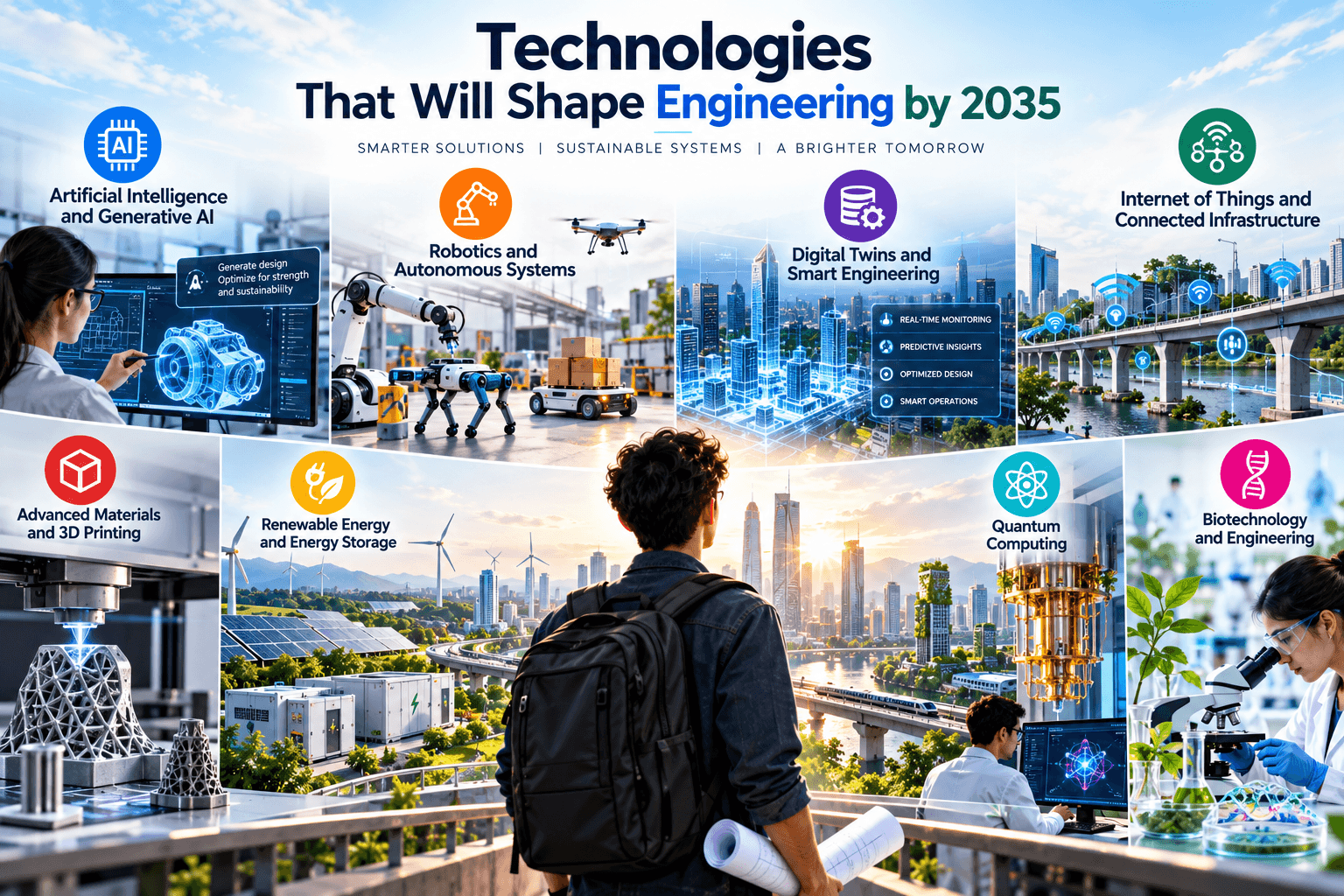
Engineering has always evolved alongside technology. From steam engines and electricity to computers, smartphones and artificial intelligence, every technological shift has changed the way engineers think, design and solve problems. As we move towards 2035, this transformation is expected to accelerate even further.
For engineering students from the best private engineering college in Jaipur, understanding these changes is not only about knowing which technologies are popular. It is about recognizing how engineering itself is changing and what skills future engineers may need to develop. Technologies such as artificial intelligence, robotics, digital twins, advanced materials and renewable energy are likely to become a much bigger part of engineering education and professional work over the next decade.
Artificial Intelligence and Generative AI
Artificial intelligence is already influencing engineering, but its role is expected to become much deeper by 2035. Engineers may increasingly use AI to analyze large datasets, identify design problems, optimize systems and automate repetitive tasks.
Generative AI could also change how engineers approach design. Instead of manually creating every possible design variation, engineers may describe a requirement and use AI-powered systems to generate multiple possible solutions. Human engineers will still be responsible for understanding constraints, evaluating results and making critical decisions.
This means future engineering students will benefit from learning not only traditional engineering principles but also data analysis, machine learning and responsible use of AI tools.
Robotics and Autonomous Systems
Robots are moving beyond traditional factory environments. By 2035, robotics could play a larger role in construction, healthcare, agriculture, logistics, manufacturing and infrastructure maintenance.
Autonomous machines may be able to inspect bridges, monitor industrial equipment, transport materials or perform tasks in environments that are dangerous for humans. Engineers will need to combine mechanical design with electronics, sensors, software and artificial intelligence to develop these systems.
The rise of robotics also highlights an important change in engineering. Future projects are likely to require collaboration between multiple engineering disciplines rather than treating mechanical, electrical and software engineering as completely separate fields.
Digital Twins and Smart Engineering
A digital twin is a virtual representation of a physical object, building, machine or system. Engineers can use data from sensors and real-world operations to monitor and analyze its digital counterpart.
By 2035, digital twins could become increasingly common in areas such as manufacturing, transportation, energy and construction. Imagine an engineer being able to monitor the performance of a factory or a large structure through a digital model and identify potential problems before they become expensive failures.
For students, this means skills in simulation, sensors, data analytics and 3D modeling could become increasingly valuable.
Internet of Things and Connected Infrastructure
The Internet of Things, or IoT, connects physical devices to digital networks so they can collect and exchange data. Its influence is likely to expand considerably as more buildings, vehicles, factories and infrastructure become connected.
Engineers could design smart buildings that automatically manage lighting and energy consumption, factories that monitor machinery in real time and transportation systems that respond to changing traffic conditions.
However, greater connectivity also brings greater responsibility. Engineers will need to consider security, data privacy and system reliability while designing connected products and infrastructure.
Advanced Materials and 3D Printing
The materials used in engineering are also changing. Researchers are developing materials that are lighter, stronger, more durable and capable of performing specialized functions.
Alongside this, additive manufacturing, commonly known as 3D printing, is changing how certain components can be designed and produced. Instead of manufacturing an object by removing material from a larger block, engineers can build complex components layer by layer.
By 2035, advanced materials and additive manufacturing could contribute to lighter aircraft, more efficient vehicles, customized medical devices and innovative construction methods. Engineers who understand both material science and digital manufacturing may find themselves working at the intersection of several disciplines.
Renewable Energy and Energy Storage
The transition towards cleaner energy will create significant opportunities for engineers. Solar and wind power are already expanding, but future energy systems will require more than renewable generation alone.
Engineers will also need to develop better batteries, energy-storage systems, smart electricity grids and efficient power-management technologies. Electric vehicles and distributed energy systems will further increase the demand for innovative solutions.
This makes renewable energy an important area not only for electrical engineers but also for mechanical, civil, chemical, electronics and computer engineers.
Quantum Computing
Quantum computing is still an emerging field, but it could influence engineering in ways that are difficult to fully predict today. Quantum computers use principles of quantum mechanics to approach certain computational problems differently from conventional computers.
As the technology develops, it could contribute to areas such as materials research, optimization, simulation and complex engineering calculations. It may take time before quantum computing becomes a mainstream engineering tool, but students who develop an early understanding of quantum technologies could be better prepared for future developments.
Biotechnology and Engineering
The boundaries between engineering, biology and medicine are becoming increasingly connected. Biomedical engineering, biotechnology and bio-inspired design are creating new possibilities in healthcare and manufacturing.
Engineers may increasingly work on technologies such as advanced prosthetic, tissue engineering, wearable health devices and bio-based materials. These developments demonstrate why future engineering education may require students to understand subjects beyond their traditional branch.
What Will Engineers Need by 2035?
Technology alone will not define the engineer of 2035. The ability to work with technology will need to be combined with creativity, communication, problem-solving and ethical decision-making.
An engineer may use AI to generate a design, robotics to build it and digital twins to monitor it. But the engineer will still need to understand the problem, question the results and consider how the solution affects people and the environment.
For engineering students, the takeaway is simple: do not prepare only for the jobs that exist today. Build strong fundamentals while developing curiosity about emerging technologies. Learn how different fields connect, experiment with new tools and become comfortable with continuous learning.
Concluding Thoughts
The engineering landscape of 2035 may look very different from the one we know today. Artificial intelligence, robotics, connected systems, advanced materials, renewable energy and other emerging technologies will continue to reshape how products are designed, manufactured and maintained.
Yet the fundamental purpose of engineering will remain the same: solving real-world problems and improving the way people live and work.
For today’s engineering students from the top private college for engineering in Jaipur, the future is not something that begins in 2035. It is already being built in classrooms, laboratories, startups and research centers. The engineers who learn to combine strong fundamentals with emerging technologies will be better prepared to participate in that future.