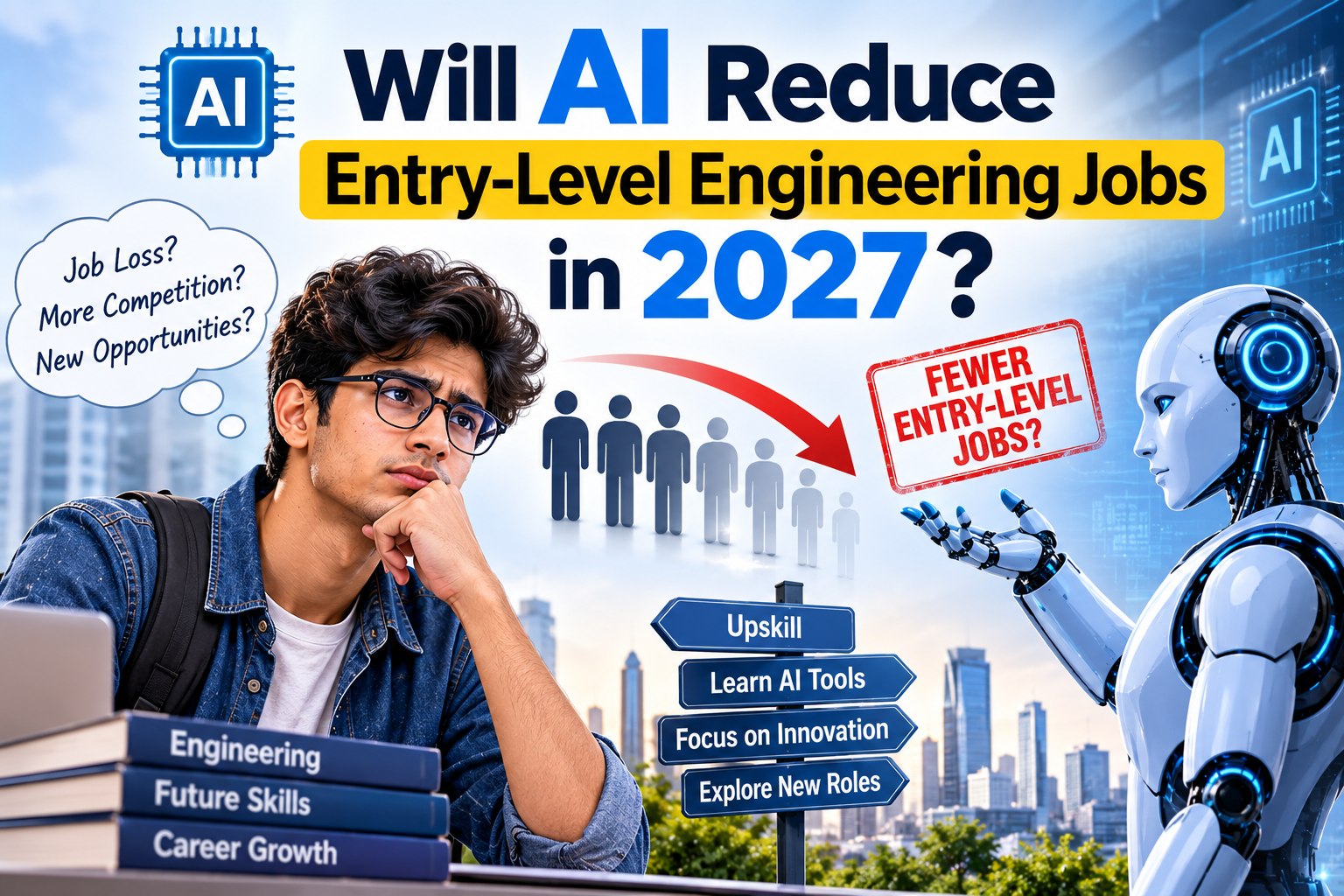
Artificial Intelligence is changing the way almost every industry works, and engineering is no exception. From writing code and analyzing data to creating designs and automating routine processes, AI tools are becoming part of the modern engineering workplace. For students preparing to graduate in 2027 from the top college for computer science engineering (artificial intelligence) in Jaipur , this naturally raises an important question: Will AI reduce entry-level engineering jobs?
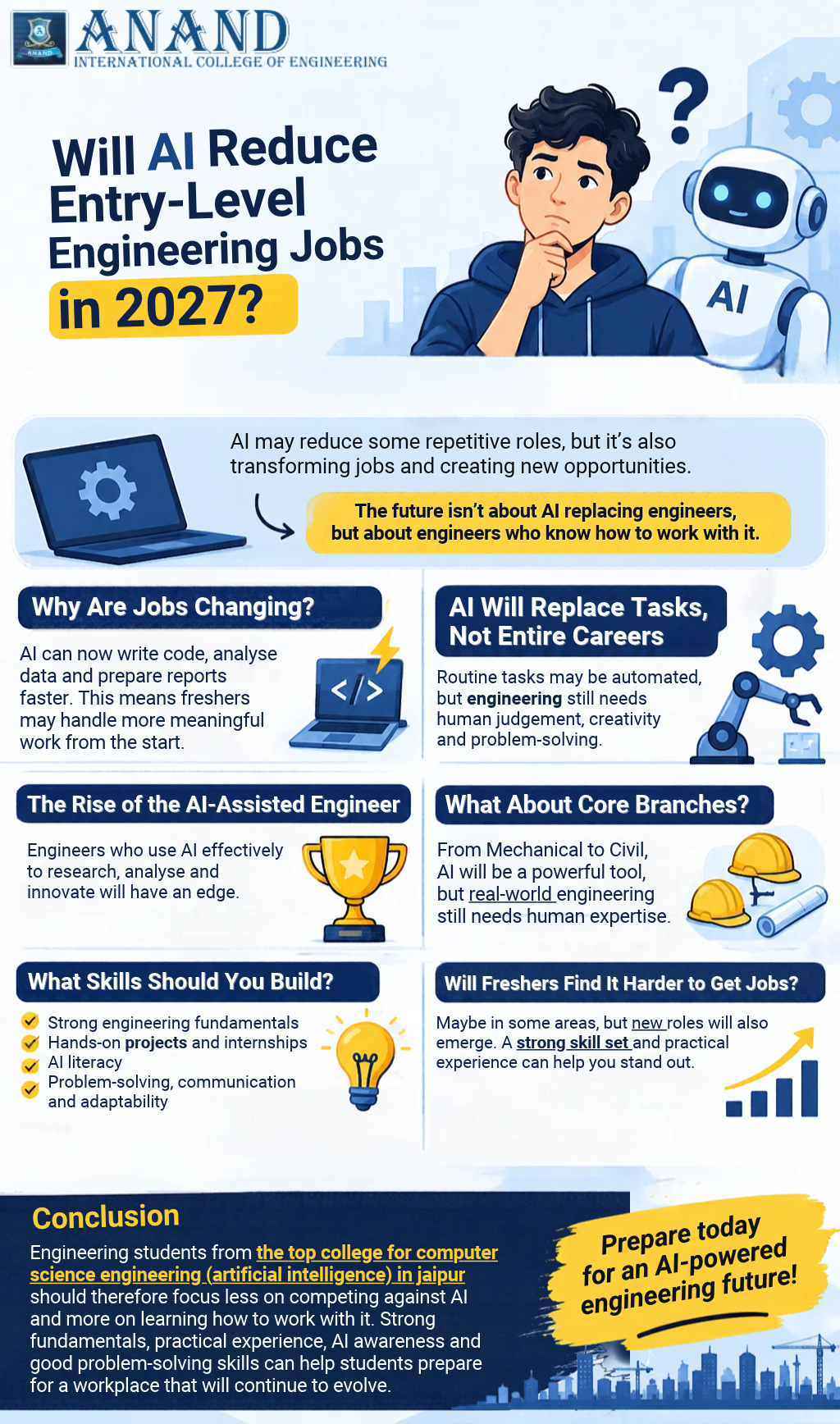
The answer is not simply yes or no. AI may reduce the need for some repetitive roles, but it is also transforming existing jobs and creating new opportunities. For engineering students, the bigger concern should not be whether AI will take away jobs, but whether they are developing the skills needed for an AI-driven workplace.
Why Are Entry-Level Engineering Jobs Changing?
Fresh engineering graduates have traditionally started their careers with relatively basic tasks. A software engineer might begin with simple coding, testing or debugging. A mechanical engineer may work on drawings and calculations, while civil engineers might assist with estimation, planning and documentation.
Today, many of these tasks can be completed faster with AI. Modern tools can generate basic code, analyze information, prepare reports, identify patterns and suggest possible solutions. This does not mean companies will stop hiring fresh graduates. Instead, employers may expect freshers to take on more meaningful responsibilities earlier in their careers.
The definition of an entry-level engineer is changing.
AI Will Replace Tasks, Not Entire Engineering Careers
Students should understand the difference between automating a task and replacing an entire profession. An engineering job includes many responsibilities. Some repetitive activities can be automated, but others require judgment, creativity, communication and technical understanding.
AI may generate a piece of code, but an engineer still needs to determine whether it is reliable, secure and suitable for the project. AI may help create a building design, but a civil engineer must consider materials, safety, site conditions and practical construction challenges. Similarly, AI can analyze machine performance, but mechanical engineers still need to understand why a problem is occurring and how it can be solved.
AI can assist engineers, but engineering decisions still require human knowledge and responsibility.
The Rise of the AI-Assisted Engineer
The engineers who succeed in 2027 may not be those who avoid AI. They are more likely to be those who know how to use it effectively.
Imagine two engineering graduates applying for the same job. Both understand the technical concepts, but one can also use AI tools to research faster, analyze information, automate repetitive work and develop solutions. That graduate may be able to contribute more quickly.
This is why AI literacy is becoming important. Students do not need to become AI experts, but they should understand how AI can support their particular engineering field. At the same time, they must be capable of checking AI-generated results rather than accepting everything the technology produces.
What Will Happen to Software Engineering Jobs?
Computer Science and IT students may notice the impact of AI sooner because coding tools are developing rapidly. AI can already generate code, identify bugs, assist with testing and explain programs. As these tools improve, jobs based mainly on simple and repetitive coding could become less common.
However, software engineering involves much more than writing code. Companies still need engineers who can understand user requirements, design systems, maintain security, work with databases and solve unexpected problems. Students should therefore focus on understanding how and why technology works instead of simply memorizing programming syntax.
What About Core Engineering Branches?
AI will influence Mechanical, Civil, Electrical and other engineering fields too. Mechanical engineers are increasingly working with robotics, automation, simulation and smart manufacturing. Civil engineers can use AI for planning, estimation, design optimization and project monitoring. Electrical engineers may encounter AI in areas such as electric vehicles, renewable energy, smart grids, embedded systems and automation.
In these fields, AI is more likely to become another powerful engineering tool rather than completely replacing engineers. Physical projects still require professionals who understand materials, machines, safety, regulations and real-world conditions.
Students studying AI, Machine Learning or Data Science may also see new opportunities. However, simply having AI mentioned in a degree will not guarantee employment. Employers will want graduates who can apply their knowledge to practical problems.
What Skills Should Engineering Students Develop?
Strong engineering fundamentals should remain the first priority. AI-generated answers are not always correct, so students must understand their subject well enough to recognize errors and make independent decisions.
Practical experience will also become increasingly valuable. Internships, technical projects, hackathons, competitions and industry exposure can help students understand how engineering concepts are applied outside the classroom. Building a portfolio of projects can show employers what a student is capable of doing rather than simply listing subjects studied during college.
Students should also explore AI tools related to their own branch. A Computer Science student might experiment with AI-assisted coding, while a Mechanical Engineering student could explore intelligent simulation and automation. Civil students can learn about digital construction technologies, while Electrical students can explore AI applications in energy and electronics.
Alongside technical knowledge, communication, creativity, teamwork, analytical thinking, adaptability and decision-making will continue to matter. These abilities help engineers deal with situations where there is no ready-made answer.
Does Every Engineer Need to Learn AI?
To some extent, yes. However, learning AI does not mean every engineering student needs to become an AI developer. Students should understand how the technology is being used within their profession.
The goal is not to turn every engineer into an AI engineer. It is to make engineers comfortable working in an environment where AI is another professional tool, much like CAD software, simulation tools or spreadsheets.
Engineering colleges will also need to support this shift by providing students with greater exposure to practical projects, modern technologies and industry problems. Classroom knowledge remains important, but students also need opportunities to apply that knowledge.
Final Thoughts
So, will AI reduce entry-level engineering jobs in 2027? It may reduce some opportunities involving repetitive and predictable work, but it will also transform existing roles and create new ones. Companies will increasingly value graduates who can understand problems, use technology intelligently and adapt to change.
Engineering students from the top college for computer science engineering (artificial intelligence) in jaipur should therefore focus less on competing against AI and more on learning how to work with it. Strong fundamentals, practical experience, AI awareness and good problem-solving skills can help students prepare for a workplace that will continue to evolve.
The engineers who stand out in 2027 will not necessarily be those who know the most about AI. They will be those who know when to use it, when to question it and how to combine it with their own engineering knowledge.