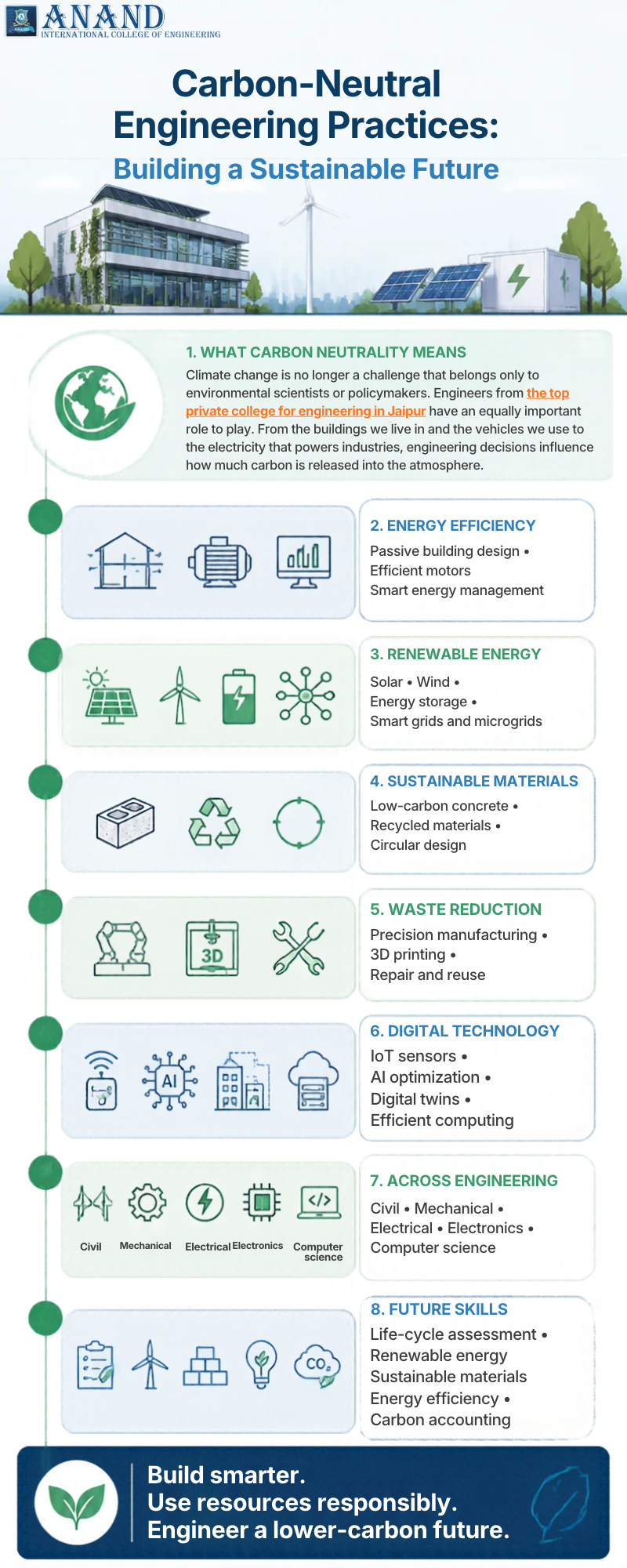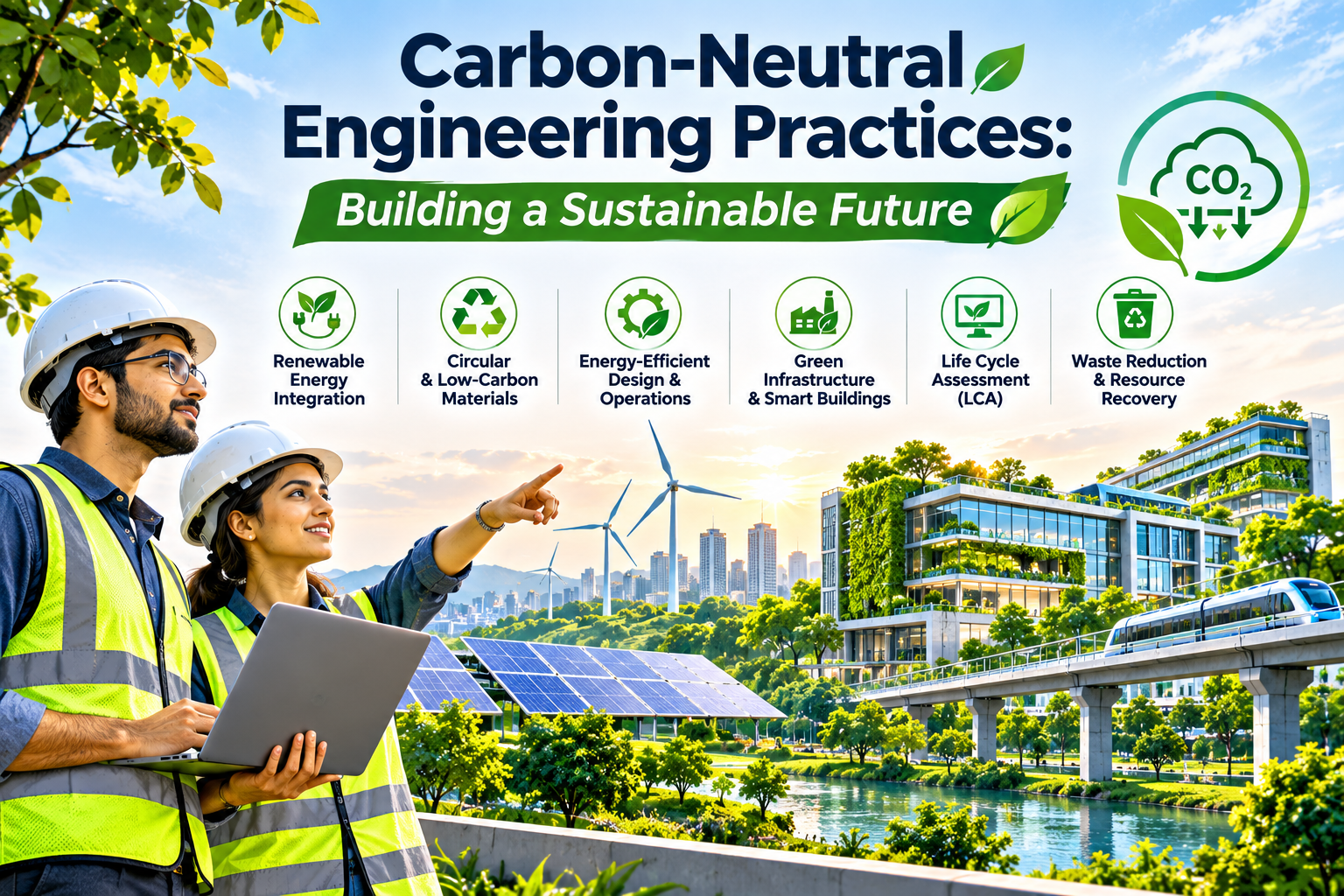
Climate change is no longer a challenge that belongs only to environmental scientists or policymakers. Engineers from the top private college for engineering in Jaipur have an equally important role to play. From the buildings we live in and the vehicles we use to the electricity that powers industries, engineering decisions influence how much carbon is released into the atmosphere. This is why carbon-neutral engineering practices are becoming an important part of modern engineering.
Carbon-neutral engineering focuses on designing, building and operating systems in ways that reduce greenhouse gas emissions as much as possible. Any remaining emissions may then be balanced through measures such as renewable energy, carbon removal or verified offsetting. The aim is not simply to make technology more efficient, but to rethink the complete engineering process with sustainability in mind.
What Does Carbon-Neutral Engineering Mean?
Carbon neutrality means achieving a balance between the greenhouse gases released and those removed or otherwise compensated for. For engineers, this means considering emissions throughout the entire life cycle of a product, structure or system.
Take a building as an example. Its environmental impact does not begin when people start using electricity inside it. Carbon emissions may already have been generated while producing cement and steel, transporting materials, operating construction machinery and managing waste. Later, additional emissions are created through heating, cooling, lighting, maintenance and eventually demolition.
Carbon-neutral engineering therefore looks at the bigger picture. Engineers need to ask how materials are produced, how much energy a system consumes, how long it will last and what will happen to its components when they are no longer required.
Designing for Energy Efficiency
One of the most practical ways to reduce carbon emissions is to use less energy in the first place. Energy-efficient design has therefore become an important principle across engineering disciplines.
Civil engineers can design buildings that use natural lighting, improved insulation and passive cooling techniques. Mechanical engineers can develop efficient motors, machines and thermal systems. Electrical engineers can create smarter power management systems, while computer engineers can develop software that monitors and optimizes energy consumption.
Even small improvements can make a significant difference when applied across factories, offices, transportation networks and cities. Instead of treating energy efficiency as an additional feature, future engineers will increasingly need to consider it from the beginning of the design process.
Moving Towards Renewable Energy
Reducing dependence on fossil fuels is another major part of carbon-neutral engineering. Solar, wind, hydro and other low-carbon energy technologies are increasingly being integrated into engineering projects.
However, installing solar panels is only one piece of the puzzle. Engineers also need to solve challenges related to energy storage, grid stability, transmission and changing electricity demand. Battery technology, smart grids, microgrids and energy-management systems are becoming increasingly important.
This creates opportunities for students from different engineering branches. Electrical engineers may work on renewable power systems, mechanical engineers on turbines and energy equipment, civil engineers on sustainable infrastructure, and computer science engineers on software that predicts and manages energy demand.
Choosing Sustainable Materials
The materials used in engineering projects can carry a large carbon footprint. Producing conventional materials such as cement, steel, aluminium and plastics often requires significant amounts of energy.
Engineers can reduce this impact by selecting lower-carbon alternatives, using recycled materials and designing products that require fewer raw resources. In construction, for example, engineers are exploring lower-carbon concrete, recycled aggregates and alternative building materials. In manufacturing, components can be designed so that they are easier to repair, reuse or recycle.
This approach connects carbon-neutral engineering with the idea of a circular economy, where products and materials remain useful for as long as possible instead of following a simple produce-use-discard cycle.
Reducing Waste Through Better Engineering
Waste represents more than unwanted material. It also represents the energy, resources and emissions used to produce something that was eventually discarded.
Modern engineering therefore focuses on reducing waste during manufacturing and construction. Digital modelling, automation, precision manufacturing and technologies such as 3D printing can help engineers use materials more efficiently.
Designing products for repairability is equally important. If a machine can be repaired by replacing one component instead of replacing the entire system, its overall environmental impact can be reduced. The same thinking can be applied to electronics, vehicles, buildings and industrial equipment.
Using Digital Technology for Sustainability
Digitization is giving engineers powerful tools for reducing emissions. Sensors and Internet of Things devices can continuously monitor energy consumption, temperature, equipment performance and other parameters. Artificial intelligence can analyze this information and identify areas where resources are being wasted.
Digital twins can also allow engineers to create virtual versions of physical systems. Instead of repeatedly testing changes on real infrastructure or machinery, engineers can simulate different scenarios and find more efficient solutions before implementation.
Technology itself consumes energy, so digital solutions must also be designed responsibly. Efficient computing, optimized data centers and thoughtful use of AI will become part of sustainable engineering discussions.
Carbon-Neutral Engineering Across Different Fields
Carbon-neutral practices are not limited to environmental engineering. Civil engineers can create green buildings and climate-friendly infrastructure. Mechanical engineers can improve industrial efficiency and develop cleaner transportation systems. Electrical engineers can support renewable power generation and smart grids. Electronics engineers can design energy-efficient devices, while computer science engineers can build systems for monitoring emissions and optimizing resources.
This makes sustainability a multidisciplinary responsibility rather than a separate engineering specialization.
Skills Future Engineers Will Need
For engineering students, understanding sustainability can become an important professional advantage. Technical knowledge will remain essential, but engineers will also need to understand concepts such as life-cycle assessment, renewable energy, sustainable materials, energy efficiency, circular design and carbon accounting.
Students should also develop problem-solving skills that go beyond asking, “Can we build this?” A more relevant question for the coming years will be, “Can we build this efficiently, responsibly and with the lowest possible environmental impact?”
Concluding Thoughts
Achieving carbon neutrality will require changes across industries, governments and society, but engineers will be among the people turning ambitious climate goals into practical solutions. Every efficient motor, low-carbon building, smarter electrical grid, recyclable product and improved manufacturing process can contribute to that transition.
For today’s engineering students from the best private college for engineering in Jaipur, sustainability should not be viewed as an extra chapter in a textbook. It is becoming part of what good engineering itself means.
The engineers of the future will not only be judged by how innovative their solutions are, but also by how thoughtfully those solutions use energy, materials and natural resources. Carbon-neutral engineering is ultimately about creating technology that moves society forward without leaving an unnecessarily heavy carbon footprint behind.